
What the Population Report counts
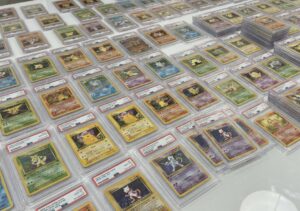
The PSA Population Report counts items recorded in PSA's certification categories. Figures change as submissions are processed. They represent neither Pokémon's print run nor the number of cards currently for sale. Each figure therefore needs the exact entry, column and observation date.
A number quoted without its label quickly loses meaning. ‘Population 100’ may mean grade 10, another grade or the total. Screenshots taken months apart do not automatically contradict one another. The first check is the scope of each observation.
Pikachu 58/102: the stamp changes the search
Base Set Pikachu 58/102 exists with and without a first-edition stamp. Name and number alone are insufficient to select a population. The stamp, edition wording and card language must match the entry. An English entry does not give the number of French cards.
The same applies to Growlithe 28/102. Search results with the same number may concern different editions. The card and certificate determine the match; results should not be automatically added together. Numbers 58 and 28 also occur in other expansions, so the set name remains necessary.
Magikarp: the same artwork with different numbering
The Magikarp 203/193 from Paldea Evolved refers to a French or English edition depending on the copy's language. In Japan, the artwork appears on Magikarp 080/073 from Triplet Beat, set code SV1a. A search based only on the Pokémon and image can therefore combine entries from different editions.
| Case | Identification on the card | Potential error |
|---|---|---|
| Pikachu 58/102 | Base Set, language and first-edition stamp | Confusion with an unstamped edition. |
| Growlithe 28/102 | Base Set, language and edition | A search limited to name and number. |
| Magicarpe 203/193 | PAL, French or English | Combining several languages. |
| Magikarp 080/073 | SV1a, Japanese | Confusion with the PAL reference. |
| Promo card | Promo number and any stamp | Combining distinct versions. |
One grade column is not the total
PSA 8, PSA 9 and PSA 10 counts remain separate from the published total. Any special categories shown by the service also need consistent treatment. A partial sum should not be labelled as the whole entry. Saving the table heading or a screenshot preserves this context.
Selection bias matters: owners choose which cards to submit. Their screening may change, as may grading costs and interest in a reference. The report is not a random sample of every card pulled from boosters.
Documenting an inconsistency before reporting it
A checking file gathers the certificate number, clear label and card photographs, the entry URL and two dated observations if a change is alleged. PSA describes a correction process for catalogue or label errors. A population difference alone does not establish such an error.
No actual counts are assigned to these five references without dated observations of their entries. The PSA population tracking sheet provides a structure for retaining the observations. The expansion index helps check printed numbers and set membership beforehand.