
TCG Insight · Collector’s guide
Building a collection.
Making informed decisions.
A coherent collection starts with a method: setting priorities, examining products, documenting purchases and planning their storage. These 20 practical tips cover decisions from the first purchase through to resale.
A collection can gain or lose value, and selling it can take time. No product, popular Pokémon or holding period guarantees a profit.
Planning a collection
A clear objective helps keep spending under control.
Defining a collecting objective
A collection can focus on a Pokémon, a language, an expansion, graded cards or sealed products. A specific objective gives purchases a consistent purpose and helps prevent an unfocused accumulation.
For a master set, the scope also needs to specify which variants count. The expansion directory lists the cards in each series.
In practiceA written objective and a short list of target cards provide a useful starting point.
Setting an affordable budget
A monthly or annual budget needs to leave room for essential expenses and emergency savings. Delivery, protective supplies, storage and any grading fees also count towards the total.
Spending for the enjoyment of collecting is separate from spending with resale in mind. An expected gain cannot justify a purchase that is unaffordable today.
In practiceRecording each expense and setting a maximum price before negotiating helps control spending.
Separating pack opening from targeted purchases
Opening booster packs is primarily a leisure activity: the contents are random and a desired card is never guaranteed. The artwork on a pack does not reveal the cards inside.
For collectors seeking a specific chase card, its individual purchase price can be compared with the proposed pack-opening budget. No number of packs guarantees that card.
In practiceA separate pack-opening budget gives the activity a clear spending limit.
Avoiding FOMO and impulse purchases
Reports of shortages or sudden price increases on social media can create urgency. FOMO can then encourage a purchase before the price and actual availability have been checked.
A cooling-off period gives time to compare sellers and completed sales. Waiting does not guarantee a lower price, but it helps keep the decision consistent with the available budget.
In practiceLeaving at least one night before an unplanned purchase gives time to reconsider.
Choosing products
Understanding a product comes before assessing its potential value.
Comparing sealed product formats
Booster boxes, half boxes, Elite Trainer Boxes, collection boxes and sleeved boosters serve different purposes. Comparisons need to account for the exact contents, expansion, language, storage space and total cost.
Booster quantities and promotional cards differ between products. The packaging description and the list of ETBs and their promo cardshelp establish what each box contains. A larger package does not guarantee a better return.
In practiceThe full product reference, contents and storage cost belong in the purchase record.
Assessing demand without assuming a safe return
Popular Pokémon such as Charizard, Pikachu and the Eevee evolutions can attract collectors. Popularity alone does not determine a card’s value or protect it against a price decline.
The artwork, edition, language, condition and sales frequency all matter. Two cards featuring the same Pokémon can have very different levels of demand. A high price may already reflect much of the current enthusiasm.
In practiceUseful comparisons involve the same card in the same condition.
Assessing special releases
Anniversary releases, collaborations and special collections may contain sought-after artwork or products. A “special” label proves neither a small print run nor the absence of later reprints.
The details that distinguish the product need checking against official announcements, rather than a seller’s claims. Temporary scarcity alone does not establish lasting rarity.
In practiceThe product’s distinguishing features and release details need to be verified.
Spreading purchases sensibly
Spending everything on one expansion or format ties the collection to demand for that particular segment. Spreading purchases can reduce that concentration when it remains consistent with the collecting objective.
Different Pokémon products still share exposure to the same market. Owning booster boxes, ETBs and individual cards does not replace diversification of personal savings. Ease of resale also matters for each product.
In practiceA spending limit for each expansion or product helps control concentration.
Recognising product formats
Exact contents and provenance matter more than the appearance of the packaging.

Booster boxes and half boxes
The stated number of packs, language, expansion and condition of the shrink wrap need checking. The familiar 18- and 36-pack formats do not apply to every release.

Elite Trainer Boxes
The exact version, contents and inclusion of a promo card need checking. ETBs do not all contain the same items.

Booster packs and pack art sets
A pack art set brings together the different wrapper designs from an expansion. The set needs to be complete and each pack’s packaging consistent with the product.

Sleeved booster packs
A cardboard sleeve alone cannot establish authenticity. The seals, provenance and consistency of the product also need checking.
Checks before buying
Product condition, provenance and seller reliability need to be considered together.
Checking seals and packaging
Seams, glue, tears, handling marks, corners and crushing all deserve inspection. A comparison needs to use the same product, since packaging can differ by format, language and release period.
Intact shrink wrap is not absolute proof of authenticity. Equally, packaging damage does not justify a fixed percentage discount in every case. Its effect depends on the product and buyers’ expectations.
In practicePhotos of every side and a retained description of any damage provide useful documentation.
Buying the actual condition, rather than an expected grade
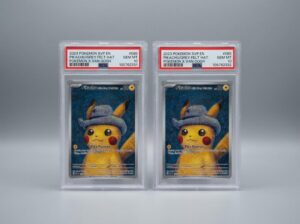
A raw or loose card is sold without a grading slab. That does not establish that it has never been graded. A card removed from a PSA 7 slab can return to the market without its former grade being mentioned.
A buyer can inspect the card’s current condition and ask for its history in writing. A claim such as “potential PSA 10” remains the seller’s opinion. The section on raw cards explains the checks and their limitations.
In practiceThe agreed price needs to reflect the documented condition, without a premium for a hypothetical grade.
Requesting useful photographs
Angled photographs, reflections and glossy sleeves can conceal defects, even unintentionally. Clear, flat photographs of the front and back, plus close-ups of corners, edges and surfaces, support an informed assessment.
A second lighting angle can reveal scratches and marks. The quality of photographs matters more than their number; further views may be needed when a detail remains unclear on an expensive card.
In practiceAny visible defect needs clarification before a purchase is confirmed.
Reviewing the seller’s history
Recent feedback, negative comments and previously sold items provide context. A 100% feedback score is not an absolute guarantee, and one isolated complaint does not establish that a seller is unreliable.
The profile, photographs, description and replies need to be consistent. Repeated reports of counterfeits or undisclosed defects deserve attention. Saved messages and the platform’s supported payment methods help retain a record of the transaction.
In practiceThe buyer protection conditions applicable to the transaction need checking.
Buying guide · Raw cards
Raw cards: checking their history before purchase
A card may have been removed from a grading slab before resale. The absence of a slab reveals neither its history nor the grade it might receive.
A PSA 7 card resold without its slab
In a hypothetical example, a collector receives a PSA 7 card, opens the slab and sells the card raw. The next buyer hopes for a 9 or 10 without knowing about the earlier assessment. Removing a slab fixes no defects and can itself damage the card.
A visually appealing card may still have a surface mark, a worn corner or uneven centring. PSA’s grading standards cover these and other factors. A new submission guarantees neither a higher grade nor an exact repeat of the earlier result.
A previous grade is not proof of deception
A card may be removed from its slab for a binder or another storage preference. The problem arises when its description conflicts with its condition or known history. A seller may also be unaware of grading that occurred before their own purchase.
Four precautions that need context
A card displayed in a shop
Display in a cabinet alone proves neither repeated handling nor previous grading. Protection, storage and the card’s condition matter more. Inspecting the front, back and surfaces outside any protective cover that obscures defects can help.
A card pulled from a pack by the seller
Documented provenance helps establish the history of a particular copy; a simple claim does not. Even a freshly pulled card can have printing, cutting or surface defects and receive a grade below 9 or 10.
Buying shortly after release
A short interval leaves less time, but does not rule out grading. PSA’s service levels have different turnaround times, including expedited options. Paying more at release therefore does not guarantee a card has never been graded.
A seller who also sells graded cards
That profile may justify questions, but proves no irregularity. Fees, turnaround times, duplicates or collecting preferences can explain a raw sale. Inconsistent listings, undisclosed defects and refusal to provide detailed photos are more useful warning signs.
Five questions for the seller
- To the seller’s knowledge, has the card previously been graded and removed from its slab?
- If so, which company graded it, what grade did it receive and what was the certification number? Is a photograph of the former slab available?
- Where did the card come from: a personal pack opening, a private purchase or a shop?
- What defects are visible on the surfaces, corners, edges or centring? Is any restoration or alteration known?
- Are recent photographs of the front, back and details available, along with a short video under different lighting angles?
What a certification check can confirm
When a previous certification number is available, PSA’s certification verification service can display the associated information. Where images are available, centring and visible marks can be compared with current photographs. A certification record alone does not prove that the card for sale is the same physical copy.
A number such as 203/193 identifies a card within a set, not an individual physical copy. Without a certification number or earlier records, no simple check can prove that a raw card has never been graded.
Before a decision. The buyer can retain the listing, photographs and replies, then check the platform’s return and protection conditions. The budget needs to allow for any grading fees and the possibility of a lower grade than expected. Where a PSA 9 or 10 is the specific objective, buying a card already assigned that grade reduces this uncertainty, alongside checks of the seller, slab and certification.
Protection and shipping
Preserving condition and documenting every transaction.
Planning suitable storage
Cards and products need protection from direct sunlight, damp and large temperature changes. Pressure on boxes and storage that compresses wrapping or corners can damage their condition.
Suitable protective supplies and periodic inspections help monitor the collection. Photographs, an inventory, invoices and purchase records are best kept separately from the physical items.
In practiceAn assigned storage location and periodic condition checks make the collection easier to manage.
Limiting sensitive information
Publishing a home address, precise storage location or photographs showing entry points can expose a collection to unwanted attention.
Where the available services allow it, delivery arrangements can limit disclosure of these details. A substantial collection also warrants an examination of the relevant insurance and storage conditions.
In practiceShipping labels need to be obscured before photographs are shared.
Packing a sold item carefully
A card needs a sleeve and suitable rigid support, secured inside a sturdy package. A collection box needs padding and an outer box that protects its corners.
Tracking, delivery confirmation and transport cover need to suit the item’s value and the platform’s rules. Tracking alone is not necessarily insurance. Proof of posting and communication through the platform help document the shipment.
In practicePhotographs of the item and its protection before the parcel is sealed provide a useful record.
Preparing to receive a purchase
Expectations can be agreed with the seller before dispatch: protection against bending, padding, corner protection and the selected shipping service. These details matter particularly for valuable cards and boxes.
The packaging and product need prompt inspection on arrival. Any problem should be documented and reported within the platform’s deadlines. Photographs or video may support a case, without guaranteeing the outcome of a dispute.
In practiceThe item needs to be checked against the listing before receipt is finally confirmed.
Tracking value and preparing to sell
Comparisons need consistent data and a net result.
Choosing when to buy
A release may bring stock shortages, restocks or rapid price changes. There is no universally best date to buy a card or sealed product.
Several listings and completed sales provide a comparison, with fees included. A maximum acceptable price also establishes when a purchase no longer fits the budget. A recent decline does not guarantee a rebound, just as a rise does not guarantee further gains.
In practiceA target price is best set before browsing new listings.
Tracking completed sales
An asking price does not prove that a buyer will pay it. Several comparable completed sales provide a firmer basis: the same card, language, edition and condition, and the same grading company and grade where relevant.
Sales frequency and fees also matter. A rarely traded product may be difficult to sell quickly. The article on Pokémon card values develops this approach.
In practiceA dated record can distinguish asking prices, sale prices and net proceeds.
Calculating the full cost
The result of a resale is more than the difference between two prices. Purchase costs, shipping, platform fees, protective supplies, any grading and other actual expenses all need to be included.
As a purely illustrative example, an item bought for €100 and sold for €130 with €20 in total expenses leaves €10 before any applicable tax. This is neither a return forecast nor a tax rule.
In practiceAn estimate of net resale proceeds helps assess a purchase in advance.
Planning a holding period and an exit
Keeping an item for a long time does not guarantee a price increase. Demand, reprints, condition and storage costs can change the case for holding it.
Reasons to hold or sell can include a changed collecting objective, space, budget or an acceptable sale price. Periodic review is more useful than treating the highest asking price seen in a listing as a reference point.
In practiceWritten resale criteria can be reviewed at regular intervals.
Before every purchase
Six checks for an informed decision.
- The card or product, language and edition are clearly identified.
- The price is consistent with several comparable sales.
- Condition, defects and provenance are documented, and any previous grading has been discussed.
- The seller and buyer protection conditions have been checked.
- The total cost remains within the available budget.
- Shipping and storage have been planned.
A guide to keep for reference
The 20 tips and checklist are also available in a clearly laid out A4 document, with page numbers and a print-ready format. This PDF is in French.
Download the guide PDF (French)10 pages · Free French PDF · October 2026 edition