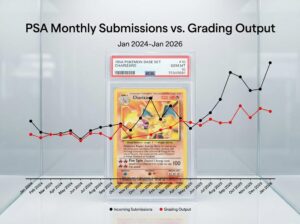


A history begins with a reliable first observation
The PSA Population Report describes items recorded by PSA. Today's snapshot does not provide previous months' figures. Without dated archives, the past cannot be reconstructed from a growth percentage or a number quoted without its original entry.
A tracking sheet links each observation to a date, exact reference and language. It records populations for grades 8, 9 and 10 separately, alongside the displayed total and entry URL. Missing observations remain blank: zero would assert that no copies are recorded in that category, which means something different.
Five French cards for a manageable tracking scope
The scope below covers five French references shown in the site's galleries. Other languages and other illustrations of the same Pokémon remain separate. This limits the number of entries to check and supports a consistent method over time.
| Town Map | Reference | Expansion | Initial observation status |
|---|---|---|---|
| Magikarp | 203/193 | Paldea Evolved | Not entered: no population validated in this table |
| Umbreon VMAX | 215/203 | Evolving Skies | Not entered: no population validated in this table |
| Giratina V | 186/196 | Lost Origin | Not entered: no population validated in this table |
| Gengar VMAX | 271/264 | Fusion Strike | Not entered: no population validated in this table |
| Charizard ex | 199/165 | 151 | Not entered: no population validated in this table |
One row per card and date
Each check adds a new row instead of overwriting the previous one. The date and time, PSA link, entry name and recorded figures remain together. A screenshot can preserve the column headings. If the category changes, a note explains the break in the series.
| Column | Expected contents |
|---|---|
| Date and time | The actual time the source was checked |
| Reference and language | Name, number, expansion and French language |
| PSA entry | Exact URL and entry name |
| PSA 8 / PSA 9 / PSA 10 | Count read from each column |
| PSA total | Displayed total with its scope checked |
| Comparable sales | Period, grade, number of sales and median |
| Notes | Category correction, missing data or exclusion |
Reading a change without automatically assigning a cause
Absolute change is the difference between two comparable observations. Relative change divides that difference by the initial count when it is above zero. An increase may reflect new certifications, but category corrections or database changes may also need checking. Entry names must remain consistent.
Certifications do not measure how many owners are willing to sell. Owners may retain their copies while ungraded cards remain in circulation. The report is therefore neither available stock for sale nor the edition's total print run.
Sales need their own collection method
Price tracking uses transactions with the same language, reference and grade within a defined date range. Each observation includes the final amount, currency, shipping and any buyer fees. Active listings remain separate because an asking price does not prove a sale.
The median can reduce the influence of an outlying amount, but it cannot correct a poor sample. Three misidentified sales do not become reliable through a formula. Transaction count, exclusions and the price range remain visible beside the result.
Charts only after several observations
Two points show a change between two dates, not a lasting rate. A longer series can use actual dates without filling gaps with invented observations. Prices and population use different units and require clearly labelled axes.
The Checking references in the PSA report comes before data collection. The comparison of raw and already graded cards then uses observed costs without predicting a grade. Simultaneous changes in population and price remain an observation, not proof that one causes the other.