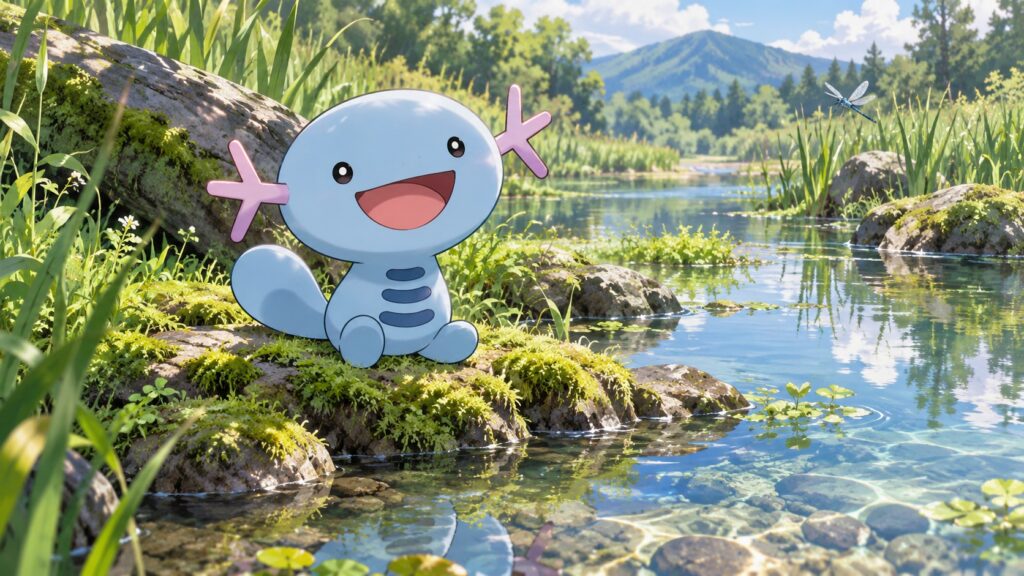
An axolotl with branching gills, a fish covered in leaf-like appendages and a caterpillar with misleading eyespots can look as though they belong in the Pokédex. These ten illustrated comparisons examine similarities without confusing observation with documented design history.
Resemblance does not prove inspiration. This selection compares visible details in real photographs and Pokémon illustrations. Without an explicit account from a creator, the animals are not presented as officially documented design models.
Ten comparisons between real animals and the Pokédex
1. The axolotl and Wooper


The branches on either side of the head immediately connect the two silhouettes. On an axolotl they are external gills; Wooper's simplified pink branches recall their shape. A broad head and elongated body reinforce the comparison.
An axolotl is an aquatic salamander, not a fish. The pale individuals often photographed in captivity do not represent all possible colours. Wooper's blue colouring belongs to the fictional character and is not an identification feature for the real animal.
2. The mudskipper and Mudkip


The mudskipper is a fish with high-set eyes and fins used for movement. Beside Mudkip, the shared features include a large head, a low body and a silhouette associated with water and damp ground.
The similarity mainly concerns the overall shape. Mudkip's upright head fin and orange cheek structures do not reproduce the photograph exactly. Comparing visible parts is more useful than seeking an animal identical to the drawing.
3. The pangolin and Sandshrew


A pangolin's scales form articulated armour. Sandshrew recalls this protection with yellow, plate-like markings and a compact stance. The comparison is clearer from the back than from the face alone.
The pangolin is a mammal; its scales do not make it a reptile. Its narrow head and long tail differ from Sandshrew's rounded proportions. The comparison shows how strongly the Pokémon simplifies the silhouette.
4. The Malayan tapir and Drowzee


The tapir's short, extended snout explains the comparison with Drowzee. The separation into two large colour areas is also noticeable, although their positions and shades differ.
The photographed tapir walks on four legs, while Drowzee is bipedal. The photograph illustrates an anatomical detail rather than reducing the entire design to a single model. Its sleep-related powers belong to fiction.
5. The platypus and Psyduck


The platypus's broad bill immediately recalls Psyduck's. Webbed feet and an association with water reinforce the similarity. The Pokémon nevertheless stands upright and has a much rounder head.
A platypus is an egg-laying mammal despite its duck-like bill. This shows why appearance alone is not enough to classify an animal. Psyduck's category and behaviour belong to Pokémon fiction rather than a zoological description.
6. The dugong and Dewgong


The dugong has a streamlined body, two front flippers and a tail adapted for swimming. Dewgong conveys a similar impression of a smooth-bodied marine mammal, adding a small horn and stylised facial details.
A dugong is not a seal. Dewgong's French name, Lamantine, should not lead to confusion between dugongs and manatees, which are distinct animals. The comparison concerns a marine silhouette rather than an exact match between a Pokémon name and a species.
7. The leafy seadragon and Dragalge


The leafy seadragon appears to carry pieces of seaweed. Its branching appendages and winding body create a clear comparison with Dragalge, whose silhouette also blends into marine vegetation.
The photographed animal is a fish. Its extensions help with camouflage and are not real leaves. Dragalge exaggerates the branches and colours, but the photograph shows that similarly elaborate forms occur in nature.
8. The manta ray and Mantine


The broad, wing-like fins create an immediate resemblance. Mantine simplifies a ray's outline into a rounder shape, with a smiling face that stands out in illustrations.
A manta ray is a cartilaginous fish, not an underwater bird. Fin edges and the lobes near the mouth provide useful comparison points. Mantine's expression is a design choice, not a description of a real ray's mood.
9. The seahorse and Horsea


The tubular snout, upright posture and curled tail make this pair easy to recognise. Horsea has a rounder body and larger eyes but retains the main features of the silhouette.
Seahorses are fish. In the photograph, the tail can grip a support; in the illustration, it also shapes the composition. A few features can identify an animal even in a highly stylised design.
10. The spicebush swallowtail caterpillar and Caterpie


The large eyespots on the Papilio troilus caterpillar stand out immediately. Its green body and apparent head shape resemble Caterpie. These false eyes are separate from the caterpillar's actual visual organs.
The photograph shows a larval stage that will become a butterfly. Biological metamorphosis differs from Pokémon evolution rules. The comparison concerns markings and proportions, without claiming that Game Freak confirmed this species as a model.
How can a resemblance be described without inventing an origin?
The first step is to identify a detail: a curled tail, external gills, a tubular snout, scales or eyespots. Comparing the rest of the body then reveals both similarities and differences, showing what the design changes, exaggerates or omits.
Three descriptions need to be distinguished. ‘Resembles’ states an observation. ‘May recall’ suggests an interpretation. ‘Was inspired by’ makes a claim about design history and requires a source for that history. A photograph caption or an online list may not provide that evidence.
Frequently asked questions
Do the photographs show real animals?
Yes. The comparison photographs come from Wikimedia Commons, with the photographer, file page and licence listed below each image. The Wooper cover is an illustration, not a wildlife photograph.
Were all these Pokémon based on these species?
That is not claimed here. The comparisons rely on visible features. Resemblance alone does not establish a designer's intention.
Why is the pika not presented as Pikachu's origin?
Pikachu's designer referred to squirrels. Similarity between the names is not evidence; the separate Pikachu article explains the distinction.
Related reading
Sources and credits
- The axolotl
- The mudskipper
- The pangolin
- The Malayan tapir
- The platypus
- The dugong
- The leafy seadragon
- The manta ray
- The seahorse
- The Papilio troilus caterpillar
Pokémon illustrations: © Pokémon / Nintendo / Creatures / GAME FREAK, shown for identification and commentary; Pokémon Database. Real photographs are credited individually. The cute Pokémon and animal selection covers were generated for TCG Insight; the other three covers show scenes from the series sourced from Pokémon.com.