Umbreon (Noctali in French) belongs to the second generation and is one of Eevee's evolutions. Its gameplay characteristics include night-time evolution, defensive statistics, abilities that affect status conditions and appearances in spin-off games.
Contents
Identity and basic details
Umbreon is a Dark-type Pokémon. Its category is Moonlight Pokémon in reference guides. Its standard measurements are 1.0 m and 27.0 kg. Its National Pokédex number is 197 in the National Pokédex.
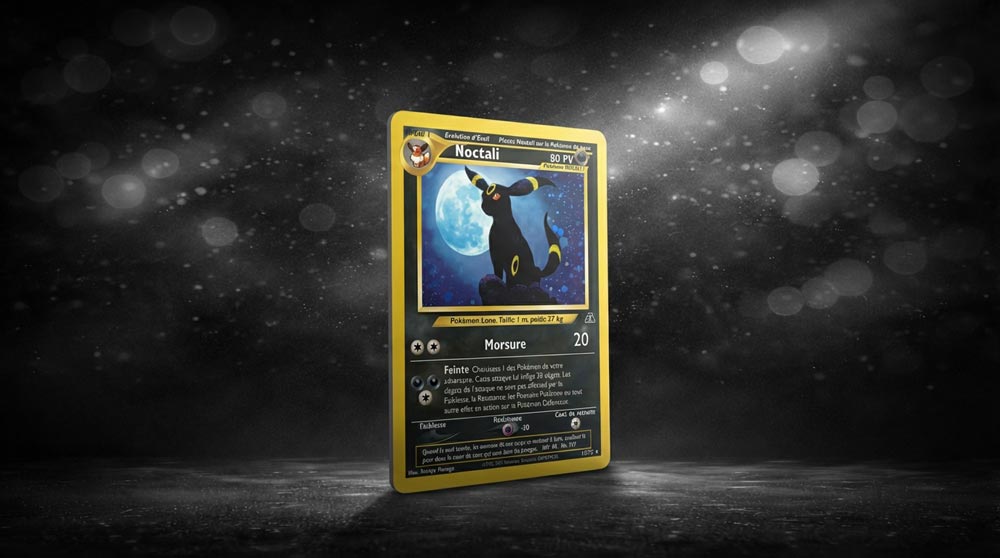
Reference guides also record its sex ratio with more males than females, and no visible difference between the sexes.
| Detail | Value | Note |
|---|---|---|
| Type | Dark | Single type, with no secondary typing |
| Height / weight | 1.0 m / 27.0 kg | Measurements for comparison with other Eevee evolutions |
| Category | Moonlight Pokémon | Consistent with its Pokédex descriptions |
| Abilities | Synchronize, Inner Focus | Synchronize can return status conditions; Inner Focus prevents flinching and, in applicable games, Intimidate |
| Base statistics | Total: 525 | Defensive emphasis, particularly Special Defence |
Appearance and identifying features
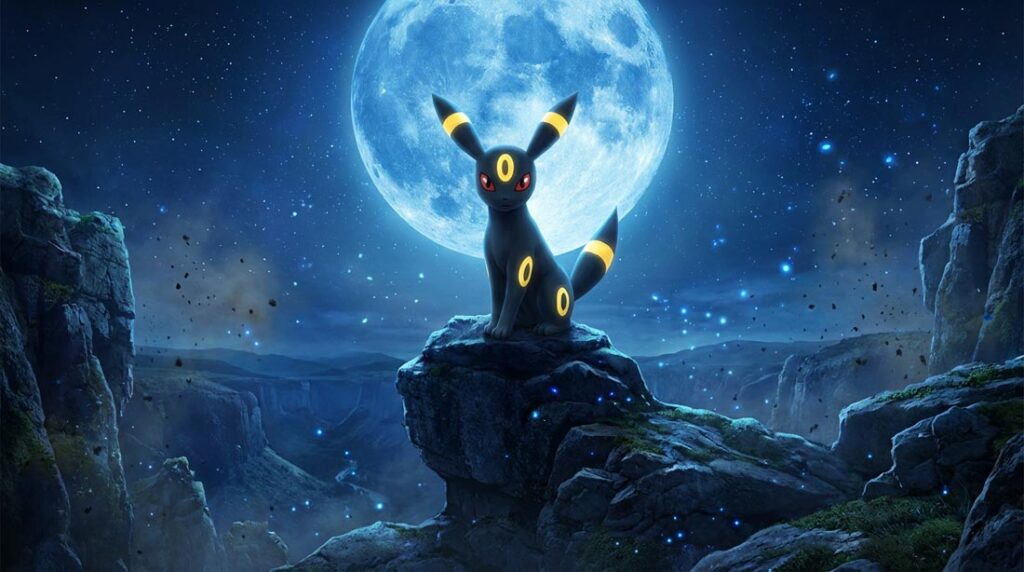
Umbreon is a black-furred quadruped, with large red eyes and yellow rings on its ears, tail, forehead and body. In animation, the rings often provide a visual signal during movement such as jumping or threatening an opponent.
Reference descriptions also suggest feline influences including black cats and wild cats, with long pointed ears.
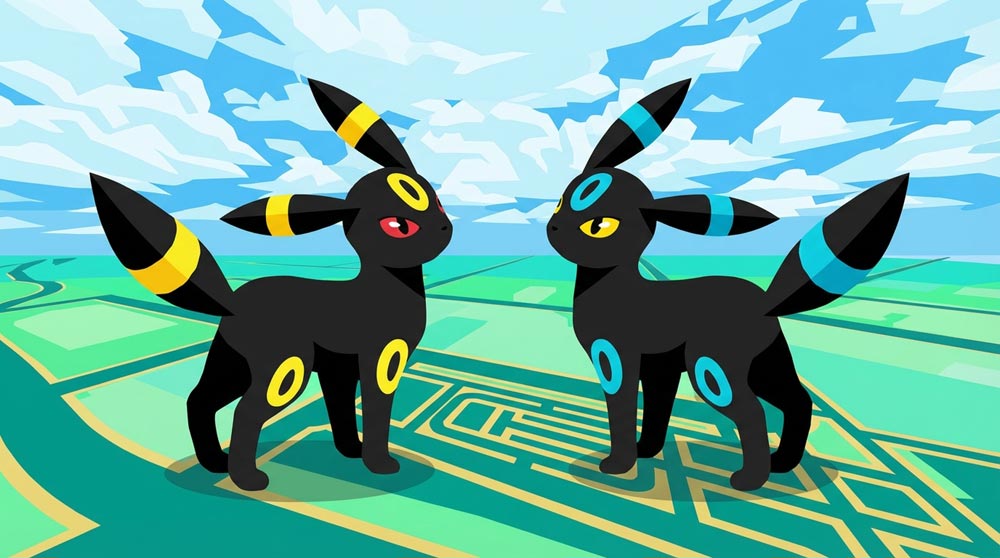
An alternative colouring is available as its Shiny form. The rings become blue or turquoise and the eyes yellow. These colour changes do not alter battle statistics, but distinguish an uncommon encounter variant.
Evolving Eevee: conditions and common mistakes
Eevee evolves into Umbreon at night with sufficiently high friendship. Other evolution conditions can take priority in some games, so the timing and available moves need checking for the particular title.
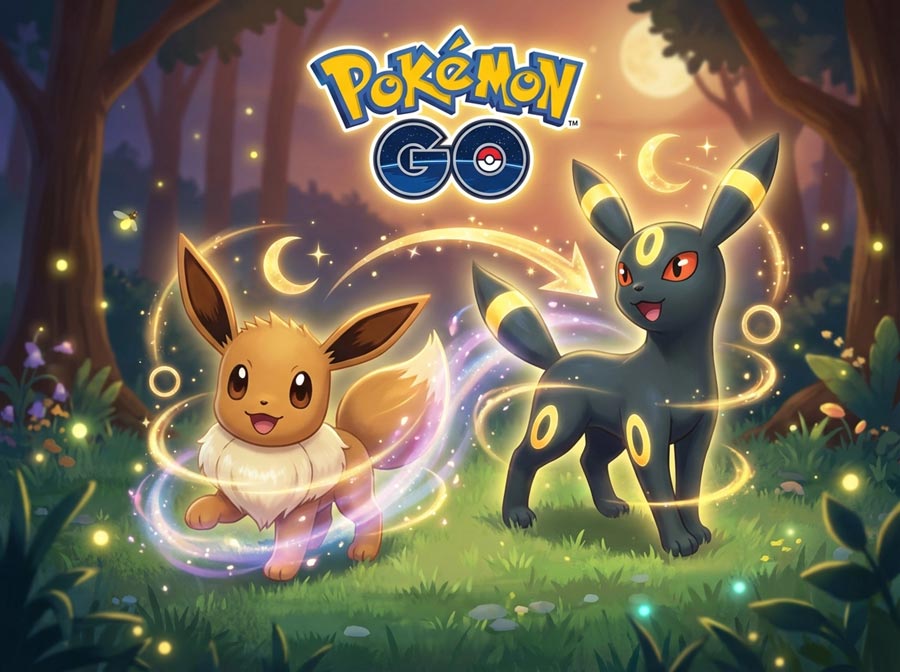
Some spin-off games use additional items or conditions, such as a moon-related item in a particular title, or ribbons and IQ requirements in certain Mystery Dungeon games. These rules differ from the main-series conditions.
- Checking in-game time : the game's night period may not directly match the real-world clock.
- Controlling the level-up : evolution needs to occur at the appropriate time.
- Checking competing conditions : another evolution can take priority if its requirements are also met.
- Checking known moves : a Fairy-type move can direct evolution towards another form in applicable games.
What Synchronize and Inner Focus do
The two listed abilities are: Synchronize and Inner Focus. Synchronize can inflict the same burn, paralysis or poison on an opponent that applies the condition. Its usefulness depends on the matchup and applicable immunity rules.
Inner Focus prevents flinching and, in games where the interaction applies, protects against Intimidate. This complements Umbreon's defensive role by reducing disruption.
The appropriate ability depends on the opposition:
- Against teams that frequently use status conditions, Synchronize can penalise repeated status attacks.
- Against flinching or Intimidate strategies, Inner Focus supports more consistent turns.
Reading Umbreon's defensive statistics
Umbreon's base statistics are: HP 95, Attack 65, Defence 110, Special Attack 60, Special Defence 130, Speed 65, for a total of 525. These values support sustained damage absorption, with more limited direct offensive pressure.
Teams often use Umbreon for support and gradual damage. High Special Defence helps it absorb special attacks, while modest Speed requires planning around turn order, positioning and support moves.
Actual statistics at levels 50 and 100 vary with IVs, EVs and nature. The broad pattern remains: Umbreon has above-average durability, particularly against special attacks, with more modest damage output.
Behaviour described by the Pokédex
Pokédex entries consistently describe Umbreon as nocturnal , active at night and able to locate prey in darkness with its large eyes. Its rings can glow in moonlight, including when it leaps.
These details help explain its design and presentation: Umbreon frequently appears in dark settings, where its luminous markings remain visible. Some games place wild encounters in specific circumstances, such as space-time distortions.
Appearances in spin-off games
Umbreon also appears in spin-offs, including as a support Pokémon in a fighting game with an area attack associated with Snarl. In Pokémon's MOBA, it is playable as a Defender, with acquisition costs in game currency and an evolution from Eevee at a specified level.
- A Defender's abilities focus on holding position, controlling space and absorbing pressure.
- A fighting-game support Pokémon has a more limited appearance governed by a gauge or cooldown.
- The applicable coin or gem costs indicate the resources needed in the relevant game.
Name origins and design influences
The French name Noctali refers to night and uses a suffix shared with other Eevee evolutions. Umbreon combines a reference to shadowwith the suffix ‘-eon’. The Japanese name Blacky reflects its dark colouring and is sometimes linked with black-cat associations.
Suggested influences include black cats, large-eared wild cats and Egyptian-style markings. These connections help explain concrete features: dark fur for contrast, luminous rings for visibility and the outline of a small nocturnal predator.
Two Umbreon cards selected for their artwork
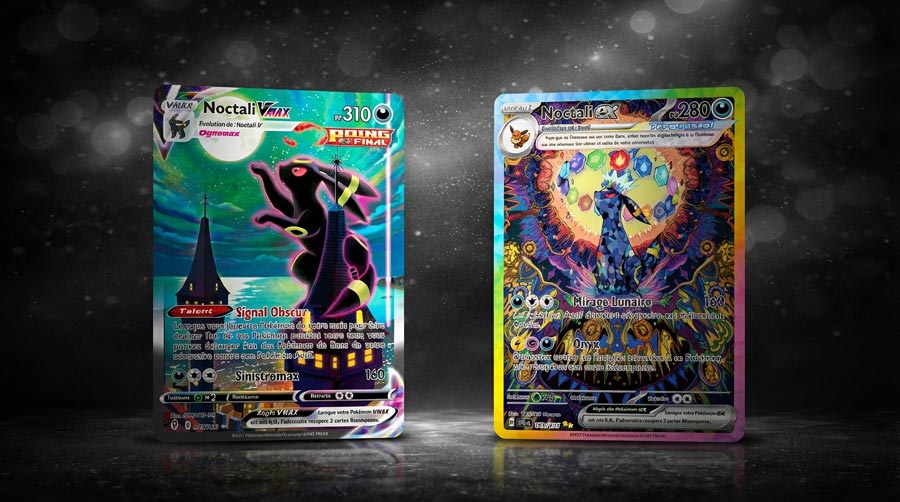
Among Umbreon's TCG appearances, two cards chase card are frequently selected for their visual compositions: Umbreon 161/131 and Umbreon 215/203. Both use dark scenes and emphasise the Pokémon's luminous rings.
The card Umbreon 161/131 comes from Scarlet & Violet — Prismatic Evolutions . The set focuses on Eevee's evolutions through different illustrations and reflective finishes. This Umbreon uses contrasting dark fur and bright markings, with detailed textures across the image.
The card Umbreon 215/203 comes from Sword & Shield — Evolving Skies . This set features Eevee's evolution line and several alternative illustrations. Umbreon 215/203 occupies a larger night-time scene shaped by moonlight, reflections and background depth.