
Recognising an illustration is not enough
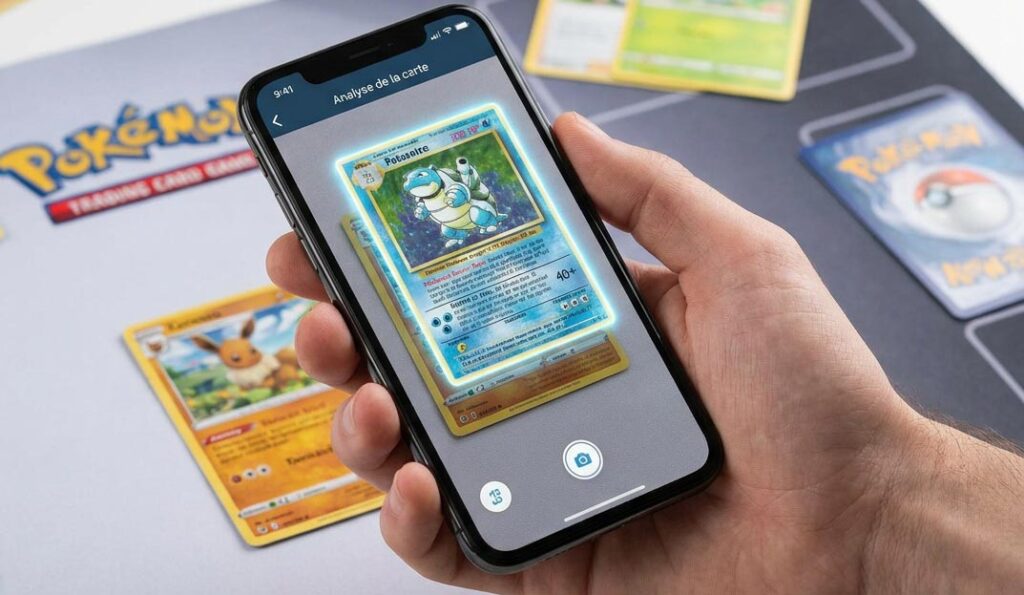
An app may find the right Pokémon but display the wrong edition. Language, reverse-holo finishes, promo cards and reprints are particular risks. A useful result matches four elements: name, number, expansion and version. A price for another version does not value the scanned card.
The phone and lighting also affect recognition. A shiny card photographed in a sleeve may reflect light over its number, leading the scanner to suggest a similar image. Manual correction is a normal part of cataloguing, but should be counted when evaluating an app.
Three apps: what their publishers describe
| Application | Documented feature | Point to check for French cards |
|---|---|---|
| Collectr | Scanning and adding cards to a collection with version management. | The language actually selected and the market used for pricing. |
| Dragon Shield — Poké TCG Scanner | Advertised recognition in several languages; TCGplayer and Cardmarket prices; CSV export. | The distinction between image recognition and pricing for the correct language. |
| Pokellector | English and Japanese catalogue; its listing describes QR-code scanning among its features. | QR scanning should not automatically be treated as identification of French cards. |
Pokellector illustrates a terminology problem: ‘scanner’ may mean a QR-code reader. Selecting apps by their title alone may therefore compare different uses. An English catalogue also does not prove that French-edition prices are calculated separately.
Twelve French cards for a comparable trial
The sample can contain three older cards, three ordinary modern cards, two holos, two reverse holos and two promos. Each app receives the same twelve cards using the same phone and lighting. Sleeved and unsleeved scans form separate trials; mixing them would make results harder to interpret.
- Record the app version, phone operating system and date.
- Timing starts at framing and ends with a usable result.
- A maximum of three attempts per card prevents open-ended testing.
- Record the first suggestion separately from the corrected result.
- Keep screenshots of errors even if a later attempt succeeds.
A results sheet that separates error types
| Field | Example entry | Interpretation |
|---|---|---|
| Expected card | Pikachu 025/165 · French · reverse holo | The starting reference is checked manually. |
| First suggestion | Name, number, language and finish | Each element receives its own assessment. |
| Attempts | 1, 2, 3 or failure | A corrected result is not an immediate success. |
| Duration | Seconds until the correct entry | Manual input is included in the total time. |
| Displayed price | Amount, currency, source and date | The kind of price is recorded beside the figure. |
| Export | Language and finish retained or lost | The exported file is checked afterwards. |
Two initial measures are sufficient: the number of entirely correct entries after the first scan, then the number correct after intervention. Ten correctly identified names out of twelve are not ten complete successes if four finishes are wrong. Language needs the same scrutiny as numbering.
Displayed prices still need context
An average, an asking price and a completed sale describe different things. Converting a dollar amount to euros does not turn it into a French-market valuation. Condition, fees and observation dates must also match the copy concerned. Unexplained differences warrant a manual search.
The card galleries organised by expansion help check the numbers. The collection management guide supports the distinction between inventory and valuation. A scanner is best assessed through the quality of its entries, corrections and exports, not merely how quickly an image appears.