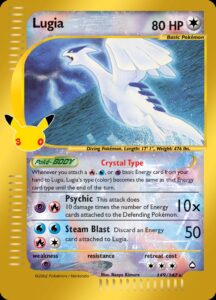
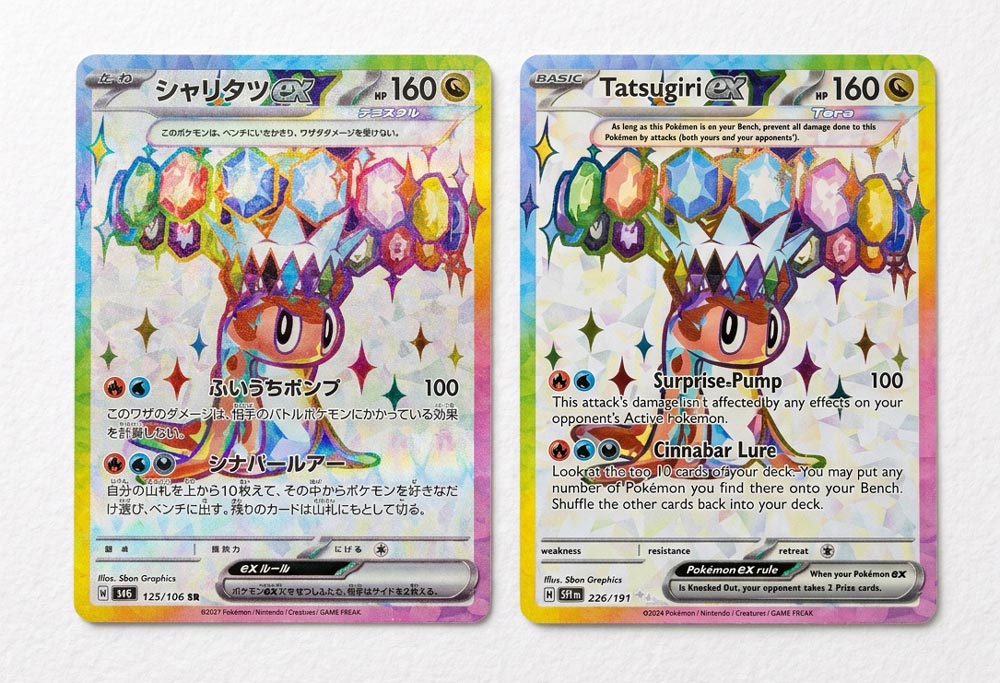
Shared artwork does not mean an identical edition
The same scene can appear in several languages under different numbers and set names. A comparison starts with the exact illustration and then the printed reference. A Pokémon's name alone is insufficient because it may have several cards within one expansion.
The card's language is separate from the listing's language. A French seller may list a Japanese card, and an English-language listing may concern a French card. The actual front, number and back need to be visible before comparing prices.
Magikarp: 203/193 in French and English, 080/073 in Japan
| Language | Name and number | Expansion |
|---|---|---|
| French | Magicarpe 203/193 | Évolutions à Paldea · PAL |
| English | Magikarp 203/193 | Paldea Evolved · PAL |
| Japanese | コイキング 080/073 | Triplet Beat · SV1a |
The official English database lists Magikarp 203/193. The official Japanese entry uses number 080/073. The Magikarp 203/193 guide covers the French reference. A search restricted to ‘Magicarpe 203’ would therefore exclude the corresponding Japanese edition.
Bulbasaur: the same number across three editions
| Language | Name and number | Expansion |
|---|---|---|
| French | Bulbasaur 166/165 | Écarlate et Violet — 151 · MEW |
| English | Bulbasaur 166/165 | Scarlet & Violet — 151 · MEW |
| Japanese | フシギダネ 166/165 | Pokémon Card 151 · SV2a |
The Japanese Bulbasaur reference retains number 166/165. The English 151 checklist and the French gallery confirm the match. Identical numbers do not mean that the three markets, available quantities or prices are identical.
These cases show why numbers should not be converted automatically. One illustration changes numbering while the other retains it. Matches need checking card by card, including the expansion code and language.
Separating raw cards from graded cards
Comparing raw cards requires similar condition descriptions and sufficient photographs. Sellers may use terms differently, and identical abbreviations do not guarantee identical flaws. A surface mark, whitened corner or crease changes the meaning of a price.
For graded cards, the service and grade remain constant: French PSA 9 against English PSA 9 and Japanese PSA 9, for example. Populations may provide context but are not automatic price multipliers. The guide to reading PSA populations explains language and category identification pitfalls.
A comparable price includes shipping and currency
The record retains the original amount, currency, transaction date and conversion rate used. Shipping, buyer fees and any applicable import costs belong in separate columns. Otherwise, an apparent price gap may reflect transport and fees rather than language.
| Condition | Treatment in the record |
|---|---|
| Same illustration but different condition | Two separate groups. |
| Raw card against PSA 10 | Excluded from the language comparison table. |
| Asking price with no completed sale | An active listing, not a transaction. |
| Unknown negotiated final price | Not usable as a confirmed sale amount. |
| No comparable sale during the period | Missing data, without automatic estimation. |
The choice also depends on the intended collection
An artist-focused collection may include several languages, whereas a complete French set has a different scope. Budget should not erase that purpose. A cheaper card in another language may still be irrelevant to the intended binder.
The Pokémon card buying guide helps define that scope. Once references are identified, comparisons concern specific copies and documented costs. No language is systematically better than another; each card has its own sales context.