
A Pokémon card valuation starts with its exact reference and comparable sales. A Pokémon's name, an expensive listing or a scanner result is not enough. Edition, language, condition and certification define the group with which a comparison makes sense.
References checked 29 September 2026. Calculation examples are hypothetical and do not represent a particular card's market value.
Market estimates, asking prices and completed sales: three different figures
A market valuation is an indicator calculated or published from a dataset. Its meaning depends on the method: recent sales, available listings, a multi-day average or a service's estimate. Two websites can therefore show different figures without measuring exactly the same thing.
The asking price is the amount requested by a seller. It may remain unchanged for months without a transaction. The observed sale price records a past transaction for a specific copy on a particular date. Neither guarantees the next sale amount.
The observation date matters as much as the amount. Early sales for a new expansion may be few and widely dispersed. An older, rarely traded card has another limitation: its last known sale may be several years old.
1. Identifying the correct card before comparison
Searching by name alone invites mistakes. Two Magikarp cards may belong to very different sets, and an illustration may be reprinted with different markings. The Shinji Kanda Magikarp 203/193 card shows why a search should retain the complete number.

| Criterion | Information to record | Common error |
|---|---|---|
| Reference | Full number and expansion code or name | Searching only by Pokémon name |
| Edition | Stamp, year and any reprint | Confusing a first print with a reissue |
| Language | French, English, Japanese or another language | Automatically applying a foreign-market price |
| Finish | Holo, reverse holo, texture or promo | Treating similar finishes as identical |
| Condition | Actually visible flaws | Calling a card mint based only on the front |
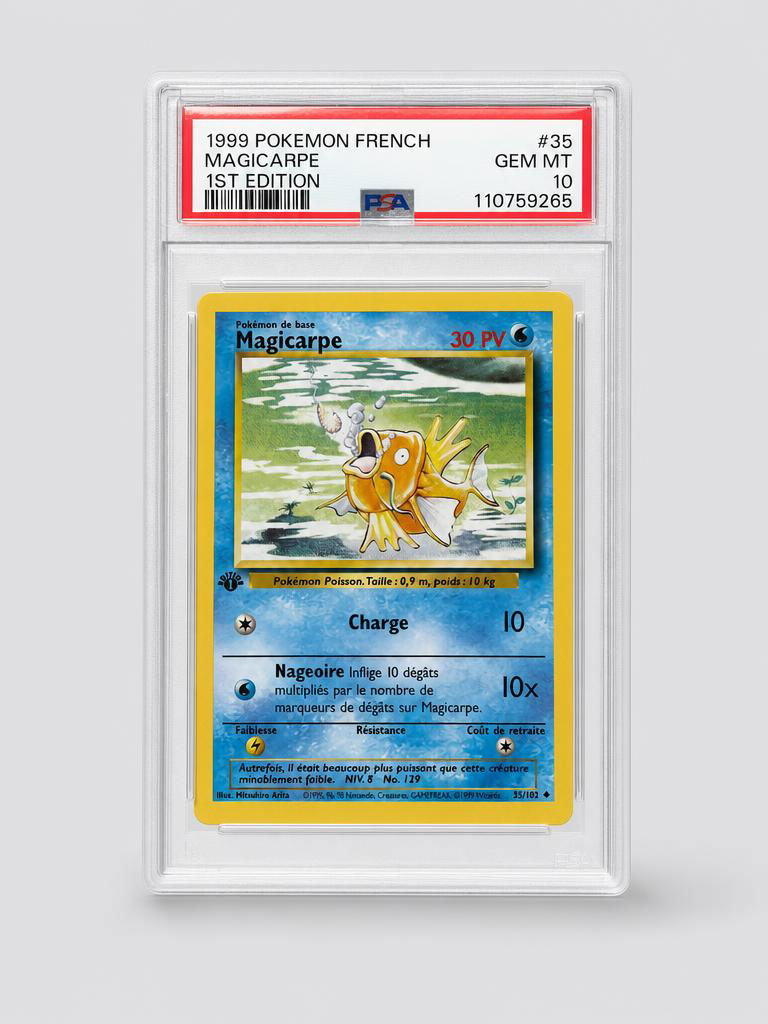
| Certification | Company, grade and certificate number | Comparing a raw card with a PSA 10 |
The index of expansions and their cards helps identify the set. French cards are not systematically more or less expensive than English or Japanese versions; comparison must be edition-specific.
2. Describing condition without overstating it
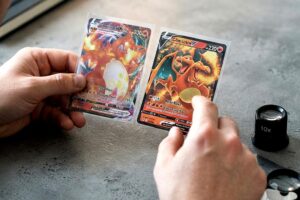
Inspection begins with clear, glare-free front and back photographs. Side lighting reveals some scratches, pressure marks and print lines. All four corners and edges need close-ups, especially where white wear appears on the back.
- Surface: scratches, stains, creases, pressure marks and printing flaws.
- Edges and corners: whitening, small chips, rounding and impacts.
- Centring: border widths and artwork position.
- Structure: creases or warped card stock, distinguished from sleeve reflections.
The Cardmarket's condition guide distinguishes Near Mint, Excellent, Good, Light Played, Played and Poor, among other categories. These do not automatically convert to PSA grades. A newly opened card may have manufacturing flaws and does not automatically qualify for the highest condition category.
No universal discount percentage applies to damaged cards. A crease differs from a few white spots, and buyers' reactions depend on the card. Comparing copies with similar flaws is more reliable than choosing an arbitrary reduction.
3. Comparing Cardmarket and eBay data
Cardmarket: distinguishing indicators from listings
The correct version's page provides listings and several indicators. The lowest available price, trend and averages over different periods answer different questions. The cheapest listing may be another language or lower condition.
The price files published by Cardmarket are updated daily according to the service's documentation. They do not replace examination of comparable copies. An overall chart should not automatically be treated as a French Near Mint valuation.
eBay: prioritising transactions while recognising limits
The Sold items filter identifies listings that resulted in sales. Completed listings may also include unsold items. Lots, graded cards and counterfeits must be separated from the authentic raw reference being researched.
The eBay Product Research tool provides additional data, including actual negotiated prices. A crossed-out amount on a sold listing does not always reveal the accepted final price. Shipping and currency also need recording.
Scanners and aggregators: help with sorting
A scanner may speed up binder identification but confuse finishes or match a French card to a foreign entry. One photograph also does not reveal every surface flaw. Reference, language and data date therefore need checking.
A service that gives no source, calculation period or tracked version produces a difficult-to-verify figure. Missing values do not mean a card is worthless; transactions may simply be scarce.
4. Building a range from sales
An initial record may contain five to ten comparable sales from the previous thirty days when trading is frequent enough. For fewer transactions, the period can extend to ninety days while preserving dates. This sample size is a working guide, not a sufficient statistical rule by itself.
Each row retains reference, language, condition, date, card price and shipping. Duplicate records and lots are flagged. An unusual sale needs its photographs and description checked before inclusion or exclusion.
The median is the middle value of a sorted series. It limits an isolated figure's influence but cannot correct misidentified references. A useful estimate states the number of sales, period and a range consistent with the examined copy without promising a price.
5. Treating graded cards separately
A grade belongs to the issuing company's scale. PSA 9, PSA 10 and raw cards have separate sales histories. The PSA grading scale considers corners, surface, printing and centring, among other features.
No fixed multiplier converts a raw-card price into a PSA 10 price. The premium depends on the card, grade and available sales. The recorded population at a grade does not describe every ungraded copy still in circulation.
The PSA certificate verification checks the number against recorded details. By itself it cannot authenticate a seller's item; the holder, label and photographs still require examination.
Before submission, the calculation includes grading, return shipping, any insurance and resale fees. Several possible grades need consideration. The guide to PSA certification through GCC covers the practical process.
From sale price to money actually retained
A card's price differs from the seller's net proceeds. Fees depend on the platform, account status and services used. The following amounts explain the method rather than reproduce a platform's fee schedule.
| Item | Hypothetical amount |
|---|---|
| Card price | 100,00 € |
| Shipping paid by the buyer | + 5,00 € |
| Assumed selling fees | −€6.00 |
| Actual shipping cost | −€5.50 |
| Protection and packaging | −€1.50 |
| Net proceeds before acquisition cost and any tax | 92,00 € |
The €92 is not profit if the card was previously purchased. Acquisition cost and other expenses still need deducting. For a collection, the Pokémon budget tracking guide helps separate purchases, fees and receipts.
Why a collection may sell below the sum of individual valuations
Adding individual prices assumes every card finds a buyer at the chosen amount. A bulk sale transfers sorting, photography and resale work to someone else. Contents, duplicates and condition therefore affect negotiation.
A clear inventory separates higher-value cards, common references and damaged copies. Each card contributing materially to the total needs a photograph. A useful estimate compares two scenarios: individual sales with their fees, and one bulk sale.
Frequently asked questions about valuation
Is a shiny card always expensive?
No. Finish alone is insufficient. Availability, exact version, condition and observed transactions determine the estimate. A common shiny card may sell for a small amount.
Is an older card always worth more?
No. Age must be considered alongside edition, condition and demand. An old damaged card and a rarely traded modern card cannot be compared by printing date alone.
Can a free estimate be reliable?
Yes, when it uses identical references, dated sales and sufficient photographs. Whether a tool is free or paid does not guarantee data quality.
What record should be kept after valuation?
A dated sheet with reference, language, condition, selected sales links, fees and the calculated range. It supports a fresh comparison when the market changes.